
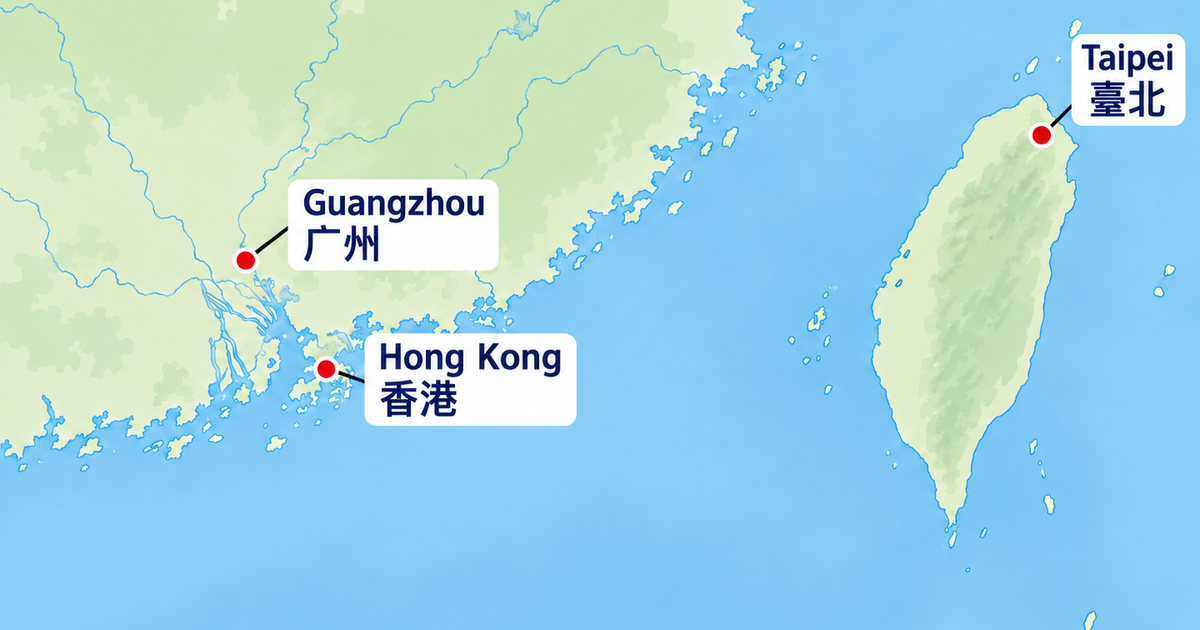
U.S. immigration law is federal, but immigrant visa processing is not identical at every visa-issuing post. Each post may have its own procedures, document practices, appointment logistics, communication methods, and local expectations.
Familiarity with local law can matter too. For example, whether a marriage, divorce, or adoption is valid—and whether a parent-child relationship qualifies under U.S. immigration law—may depend on the law of China, Hong Kong, or Taiwan. Similarly, whether criminal history makes a person ineligible for a visa may turn on interpretation of local law.
Through staff based in the region, our firm regularly provides representation for immigrant visa applicants at the following posts:
- U.S. Consulate General Guangzhou: This is the only post in China that processes immigrant visas.
- U.S. Consulate General Hong Kong and Macau
- American Institute in Taiwan, Taipei Office
Because our firm deals with these posts regularly, we may be able to proactively deal with key issues that an attorney unfamiliar with these posts might not anticipate before the visa appointment. Just a few examples are outlined below. Feel free to schedule a consultation with our firm to see how we can help you.
U.S. Consulate General Guangzhou
1. China Birth Certificate: If you were born in Mainland China, you will need to submit a notarial birth certificate (NBC) in support of your immigrant visa application. An application for an NBC is filed with a notary public with jurisdiction over the Public Security Bureau office where your household registration (户口 hukou) is currently located, or was canceled, or where you were born. The application must be filed in person by you or by a person to whom you give a power of attorney. For persons born in 1996 or later, the key evidence to submit to the notary is your medical certificate of birth (出生医学证明 chusheng yixue zhengming). For persons born earlier, the key evidence to submit is usually a certificate issued by the local police station listing your birth circumstances (name at birth, date and place of birth, parents names). For more, see How to Apply for a Notarial China Birth Certificate. In a relatively small number of cases, an NBC may be unobtainable, in which case an applicant must submit secondary evidence of their birth circumstances.
2. Communist Party Members: The U.S. Immigration and Nationality Act bars certain persons who have been members of or affiliated with the Communist Party from being issued immigrant visas. Affiliation may include employment in government, State-owned enterprises, nongovernmental organizations and quasi-governmental organizations, or as a military officer. Exceptions exist, such as for persons whose membership or affiliation ends 5 years before applying for a visa. Waivers are available for certain persons who are the parent, spouse, son, daughter, brother, or sister of a U.S. citizen; or the spouse, son, or daughter of a lawful permanent resident. See Communist Party Membership May Make You Ineligible for a U.S. Green Card or Naturalization.
3. China Police Certificate: You may be required to submit a China police certificate if you are age 16 or older and are a national of China, are a current resident, have lived in China for 12 months, or have been arrested in China. See How to Apply for a China Police Certificate.
4. Questions During the Medical Exam about Drug and Alcohol Use: During the medical exam, the physician will ask about your medical history. You may be asked about drug and alcohol use. If your answers or your behavior and appearance raise concerns, you may be asked to undergo urine and blood testing for drugs and alcohol. Remember:
- If the physician determines that you now have or previously had an alcohol or drug-abuse related disorder and behavior associated with that behavior that has posed or may pose a threat to the property, safety, or welfare of you or others, you may be refused a visa until you prove sustained, full remission.
- A person who is convicted of or admits to violating a controlled substance crime in any country is generally ineligible for an immigrant visa. This includes use of marijuana in the U.S., regardless of the amount used or whether it was for medical purposes. Marijuana possession is a crime under U.S. federal law, regardless of whether a state has legalized it.
U.S. Consulate General Hong Kong and Macao
1. Exactly which documents must be uploaded to CEAC and physically brought to the interview. Hong Kong warns that, since July 1, 2025, applicants who have not uploaded all required documents and brought all required documents may be turned away and required to reschedule.
2. Hong Kong police certificates (CNCCs). The Hong Kong Certificate of No Criminal Conviction follows an unusual procedure: it is generally sent by the police directly to the U.S. Consulate, rather than handed to the applicant. Hong Kong Police procedures also changed substantially in 2026, including online applications and new procedures for overseas applicants.
3. Hong Kong criminal-record documentation. If there has been a conviction, the post specifically refers to documents such as the Hong Kong court’s Certificate of Trial and the Hong Kong Police Brief Facts of Case, in addition to translations and copies.
4. Validity of older Hong Kong marriages and divorces.
- Before October 7, 1971, a customary Chinese marriage could be dissolved by mutual written consent signed before two witnesses. After that date, ordinary court divorce procedures apply. Whether an earlier marriage was validly terminated can determine whether a later marriage is valid and therefore whether the qualifying spousal or stepparent relationship exists.
- For Hong Kong divorces, a Decree Nisi (interim order) is not the same as the final Certificate of Decree Absolute. An applicant who remarried after obtaining only the Decree Nisi can therefore present a serious petition-validity problem rather than merely a missing-document problem.
5. Applicants from the Philippines. All applicants born in the Philippines or who carry a passport issued by the Government of the Philippines and who are over the age of 16 must submit a Certificate of No Marriage Record (CENOMAR) issued by the Philippine Statistics Agency. The U.S. Consulate will not accept this document if received directly from the applicant; it must be received by the Consulate directly from the PSA.
American Institute in Taiwan, Taipei Office
1. Household Registration Transcript: For a Taiwanese citizen born in Taiwan, AIT does not accept an ordinary birth certificate. It requires the Individual Household Registration Transcript (HRT or 戶籍謄本) in both English and Chinese, with full remarks, issued within the preceding year. AIT currently asks for two sets.
2. Taiwan marriage and divorce documentation. Taiwan’s rules are date-sensitive. Marriages occurring on or after May 23, 2008 generally become effective upon registration with the Household Registration Office, whereas earlier marriages could be valid without registration if the applicable witness requirements were satisfied. A consensual divorce must be registered, and a valid divorce should be reflected in the individual’s Household Registration Record. Those distinctions can matter directly in determining whether a petitioner-beneficiary marriage is valid.
3. Older Taiwan Adoptions and Parent-Child Relationships. Whether an adoption or other parent-child relationship qualifies under U.S. immigration law may depend on Taiwan law in effect at the time the relationship was created and on Taiwan household-registration records. Published BIA decisions have specifically analyzed Taiwan adoption law and treated household-registration records as important evidence of family relationships.
4. Taiwan versus mainland-China visa chargeability. This can be surprisingly consequential in employment- and family-preference cases. Immigration-visa chargeability generally follows place of birth, not citizenship or current residence. DOS lists Taiwan as its own chargeability area, separate from “China—mainland born.” Thus, a Taiwan citizen born in Shanghai ordinarily does not become chargeable to Taiwan merely by acquiring Taiwan nationality or residing there; conversely, a Taiwan-born applicant ordinarily receives Taiwan chargeability. Alternate chargeability through a spouse or parent can sometimes change the result. This can determine whether a visa number is immediately available.
5. Taiwan Police Certificates. A Taiwan Police Criminal Record Certificate is not necessarily a complete record of the applicant’s criminal history. It may omit convictions involving fines, probation, suspended sentences, imprisonment of less than six months, and juvenile offenses. A “clean” certificate therefore does not necessarily resolve a criminal-inadmissibility issue.
Leave a Reply