
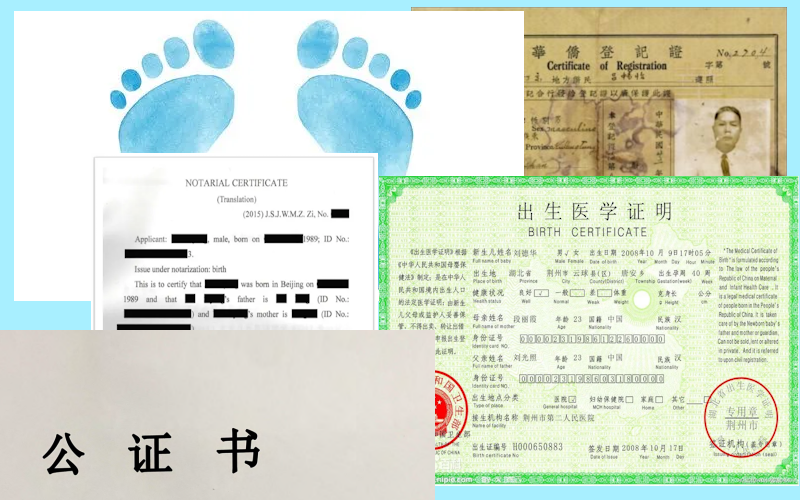
If you were born in Mainland China, you may need a notarial birth certificate (NBC) for purposes such as applying for immigration or citizenship in another country, such as the United States, Canada, Italy, Portugal, etc.
An application for an NBC is filed with a notary public with jurisdiction over the Public Security Bureau office where your household registration (户口 hukou) is currently located, or was canceled, or where you were born. The application must be filed in person. If you are unable to apply in person because you are outside China, a third party with a power of attorney (委托书 weituoshu), such as Chodorow Law Offices, can apply on your behalf.
A. Get Started: Schedule a Consultation
Step 1:
Schedule a consultation by filling this online form and uploading available documents from this list.
Step 2:
Pay the Consultation fee. You can find payment details here.
Step 3:
In some situations, we may ask you to complete a questionnaire regarding the circumstances of your birth.
Our firm will then contact you to schedule a mutually agreeable time for the consultation. During the appointment, we will speak with you and review the relevant documents to learn your goals and the relevant facts. The initial consultation is confidential. It can be in English or Mandarin (or an interpreter can be arranged for another language). Plan for it to take 60-90 minutes. We will:
- Confirm the facts to be listed in the NBC.
- Determine what documents will be needed for the NBC application.
- Explain the requirements and procedures for the NBC application.
- Estimate the odds of whether the NBC will be issued or will be denied. If it is denied, and you are applying for U.S. immigration benefits, you may need to submit evidence proving the NBC is unobtainable and secondary evidence of the circumstances of birth.
- Answer your questions.
Follow-up research and quote: After the initial consultation, the next step will be to research with the notary their local office’s requirements and procedures. Then, we will provide you with a written quote and proposed strategy for the case. (Please note that some cases may require research with other agencies, such as the public security bureau’s household registration department, the hospital where you were born, or a work unit holding a personnel file for you and a parent. There may be a charge for such research.)
B. Two Types of China Birth Certificates the Notary Can Issue
There are two types of NBCs that can be issued to describe the circumstances of a person’s birth:
Type 1: Birth certificate notarization (出生证公证 chushengzheng gongzheng)
People born in 1996 or later should have a medical certificate of birth (出生医学证明 chusheng yixue zhengming). That certificate should be issued by the hospital or medical clinic where the individual was born, or by the public health administration based on the report of a professional who assisted with a home birth. Issuance of such certificates is mandated by the Law on Maternal and Infant Health Care, article 23 (1994).

The first type of NBC is a “birth certificate notarization,” meaning a photocopy of the medical certificate of birth with an attestation by the notary that the photocopy is in “conformity” with the original, and that the original is “authentic.” The notarial certificate lists the “issue under notarization” (公证事项) as “birth certificate” (出生医学证明). Here is a sample:

Type 2: Birth notarization (出生公证 chusheng gongzheng)
The second type of NBC is typically applied for by showing evidence of the circumstances of birth other than the standard medical certificate of birth (出生医学证明 chusheng yixue zhengming).
Prior to standardization of medical certificates of birth in 1996, birth registration was decentralized and there was no national standard format for birth certificates.

This type of NBC is typically applied for by showing evidence of the circumstances of birth such as:
- birth certificate (出生证明书) with delivery record (病案首页), or medical certificate of birth (出生医学证明) issued by the hospital;
- record issued by the Household Registration Department of the local Public Security Bureau; or
- letter issued by the office that has control over your personnel file (人事档案), which may be:
- your work unit (for state-owned enterprises)
- university (for students)
- neighborhood committee (if not employed)
- the Administration for Industry and Commerce (if employed by a foreign company)
- talent market (人才市场) (if employed by a domestic private company)
- sub-district office (街道办事处)
Unlike the Type 1 certificate, Type 2 does not include a photocopy of the evidence the notary has reviewed. Instead, it merely describes the notary’s conclusions about the circumstances of birth. It lists the “issue under notarization” (公证事项) as “birth” (出生). Here is a sample:

Unfortunately, in some cases, there is insufficient evidence of the circumstances of birth to be able to persuade a notary to issue a Type 2 NBC. See How to Prove a China Birth Certificate Is Unobtainable for U.S. Immigration Purposes.
C. U.S. State Department Guidelines for China Birth Certificates
The U.S. State Department publishes Reciprocity and Civil Documents by Country, which provides guidelines for what type of birth certificate is required from each country.
The guidelines for China explain that a person born in mainland China must present a notarial certificate (公证书) issued by the local notary public office (公证处). These guidelines implicitly allow for submission of either a Type 1 or a Type 2 NBC.
Both U.S. Citizenship and Immigration Services (USCIS) as well as the U.S. State Department follow these guidelines:
Special Seal(s) / Color / Format: A notarial birth certificate normally contains a watermark, seal, and red stamp. It indicates the applicant’s name, gender, date of birth, ID number, place of birth, and both parents’ names. NOTE: Notarial birth certificates issued prior to 2012 may not list the ID number. All notarial documents must have an English translation, and be attached with a certificate stating that the English translation is in conformity with the Chinese original.
Issuing Authority Personnel Title: Notary Public (公证员)
Registration Criteria:
- A National ID and household registration (户口簿). If the applicant lives abroad, a copy of his or her passport is also required.
- One of the following three documents evidencing the circumstances of birth:
- Birth certificate (出生证明书) or medical certificate of birth (出生医学证明) issued by the hospital
- Initial Birth Record issued by the Household Registration Department of the local Public Security Bureau
- Proof of birth issued by the sub-district office (街道办事处) or the Personnel Department of Work Unit
- Photographs – at least two.
- A signed affidavit or authorization certificate from the applicant if someone other than the applicant applies for the certificate on his or her behalf. The authorized person also needs to provide his/her national ID.
- Documentation of both parents’ identification. If deceased, a death certificate is required.
- Other documents requested by the Notary Public (公证员).
Procedure for Obtaining:
- Complete an application and submit all relevant documents to the Notary Public Office (公证处).
- The Notary Public then examines the documents. If the application is accepted, the applicant pays all related notary fees.
- Once the review of the submitted documentation is completed, the notarial birth certificate is issued….
Comments: Applicants should check the website or contact their local Notary Public Office to obtain specific information regarding required fees and supporting documents.
D. Who is Reading This Article?
Earlier versions of this article were cited by the Canadian government’s Immigration and Refugee Board in 2016 and 2020.

This article is cited in an article titled China: Birth Certificates and Proof of Birth from the Danish National ID Centre, part of the Danish Ministry of Immigration and Integration.

E. Further Reading
- Sample NBC Type 1–出生证公证
- Sample NBC Type 2–出生公证
- Samples of Documents Used to Apply for a China Notarial Birth Certificate
- How to Prove a China Birth Certificate Is Unobtainable for U.S. Immigration Purposes
- China Joins Hague Apostille Convention
- Getting China Notarial Certificates for Your U.S. Immigration Case


Leave a Reply