
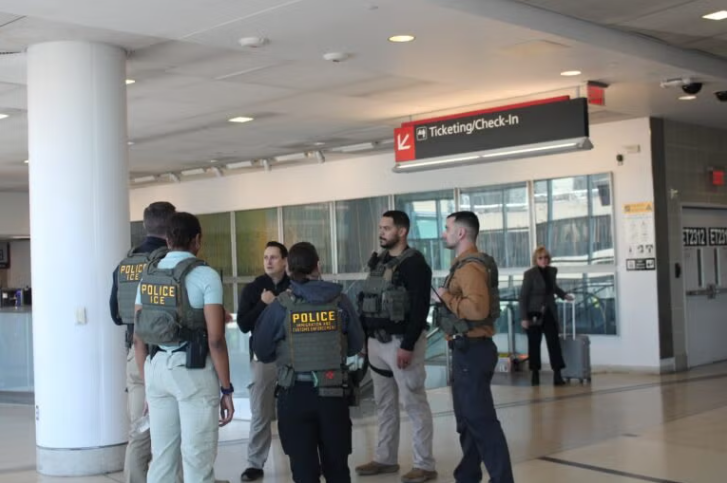
A November 2025 New York Times article, For Spouses of U.S. Citizens, Green Card Interviews End in Handcuffs, reported that some spouses of U.S. citizens have been arrested by ICE at their I-485 interviews. “In every case, agents with Immigration and Customs Enforcement [ICE] told the applicants that they had overstayed tourist or business visas.” More recently, in July 2026, there have been reports of an increase of ICE arrests of persons with pending Forms I-485 whose lawful immigration status has expired. See New York Times, ICE Arrests Surge at Airports, Opening New Front in Deportation Drive.[1] Why is this happening?
The Immigration and Nationality Act makes a foreign national subject to removal if they are “present in the United States in violation of … law”[2] or if they were admitted as a nonimmigrant but have “failed to maintain nonimmigrant status.”[3] Within the scope of these provisions are persons who have remained in the United States for longer than permitted or violated the terms of their nonimmigrant status (for example, engaged in unauthorized employment or, if admitted as an F-1 student, ceased pursing the required course of study without authorization). The mere fact that a person has applied for adjustment of status does not protect them from being subject to removal.
It is true that a person who has a “properly filed pending application for adjustment of status” is “in authorized stay and does not accrue any unlawful presence.”[4] But what that means is that the period while the Form I-485 is pending does not count as “unlawful presence” for purposes of INA § 212(a)(9)(B), the law which imposes a 3- or 10-year bar on returning to the United States for certain persons who have previously been “unlawfully present.”
So, an adjustment of status applicant who has stayed in the United States beyond the period they were admitted for or who has violated their nonimmigrant status but has a pending Form I-485 is simultaneously in a period of “authorized stay” but also subject to removal.
U.S. Immigration and Customs Enforcement (ICE) has the power—without a warrant—to arrest wany foreign national if the officer “has reason to believe” they are subject to removal and likely to escape before a warrant can be obtained for their arrest.[5]
Historically, ICE policy encouraged officers to exercise prosecutorial discretion in deciding whom to arrest. For example, a 2011 ICE memorandum expressly identified the decision “whom to stop, question, or arrest” as an exercise of prosecutorial discretion and instructed officers to consider whether a person was “likely to be granted temporary or permanent status or other relief from removal.”[6]
In contrast, a 2025 executive order by President Trump provides: “It is the policy of the United States to faithfully execute the immigration laws against all inadmissible and removable aliens, particularly those aliens who threaten the safety or security of the American people. Further, it is the policy of the United States to achieve the total and efficient enforcement of those laws.”[7]
In many cases, however, arrest and commencement of removal proceedings will not eliminate the person’s eligibility for adjustment of status. For a person in removal proceedings who has been admitted as a nonimmigrant (i.e., is not an “arriving alien”) the Immigration Judge generally has exclusive jurisdiction over the adjustment application. Thus, many such applicants may continue to pursue adjustment of status before the Immigration Court notwithstanding the charge that they are removable.
Persons with a pending Form I-485, unless they have an unexpired Form I-94 showing they are in nonimmigrant status (which they have not violated) should seriously consider avoiding air travel. Persons traveling near the U.S. land borders should also be aware that U.S. Border Patrol operates immigration checkpoints on certain highways.
Our firm’s clients should always confer with our firm before international travel.
Given the Trump administration’s increased immigration enforcement, persons with pending Forms I-485 should carry appropriate immigration documentation when outside their homes. Persons age 18 or older are generally required by law to carry evidence of alien registration. Depending on the person’s circumstances, this may include a Form I-766 Employment Authorization Document or Form I-94. As a practical matter, adjustment applicants should also consider carrying a copy of their Form I-485 receipt notice and, if applicable, their employment authorization and advance-parole documents. Persons who remain in valid nonimmigrant status should also carry evidence of that status.
[1] See also AILA Practice Alert: Reports of Increased Detention at U.S. Airports for Individuals Traveling Domestically, AILA Doc. No. 26072702 (July 27, 2026), https://www.aila.org/practice-pointers-alerts/practice-alert-reports-of-increased-detention-at-us-airports-for-individuals-traveling-domestically.
[2] INA § 237(a)(1)(B).
[3] INA § 237(a)(1)(C).
[4] AFM 40.9.2(b)(3)(A).
[5] INA § 287(a)(2).
[6] John Morton, Dir., ICE, Policy No. 10075.1, Exercising Prosecutorial Discretion Consistent with the Civil Immigration Enforcement Priorities of the Agency for the Apprehension, Detention, and Removal of Aliens 4 (June 17, 2011), available at https://www.ca1.uscourts.gov/sites/ca1/files/citations/Exercising%20Prosecutorial%20Discretion%20Consistent%20with%20the%20Civil%20Immigration%20Enforcement%20Priorities%20of%20the%20Agency%20for%20the%20Apprehe.pdf
[7] Exec. Order No. 14,159 § 2 , 90 Fed. Reg. 8443 (Jan. 20, 2025), available at https://www.whitehouse.gov/presidential-actions/2025/01/protecting-the-american-people-against-invasion/.
Leave a Reply