Contents
The Nov. 26 shooting of two National Guard members by a suspect identified as an Afghan national has triggered new immigration restrictions imposed by the Trump administration on nationals of Afghanistan, 19 “countries of concern,” and all countries:
1. USCIS Hold and Review of Certain Applications
USCIS has issued a Dec. 2 Policy Memorandum regarding:
- Hold and review of all asylum applications regardless of the applicant’s nationality.
- Hold and review of certain benefit requests by applicants from “countries of concern.”
- Re-review of approved benefit requests by applicants from “countries of concern” who entered the U.S. on or after Jan. 20, 2021.
The “hold” is effective immediately and will continue while USCIS does a “comprehensive review” of all its policies and procedures with an eye to improving vetting and screening to address vulnerabilities to national security and public safety posed by applicants. After that review, the USCIS Director may adjust policies and procedures and lift the hold through a subsequent memorandum.
The review called for may include an interview. The review will cover:
- Assessing whether the applicant is ineligible under terrorism grounds.
- Whether the applicant is ineligible because they seek to enter the U.S. to
- Engage in activities violating espionage or sabotage,
- Violate or evade any law prohibiting the export from the United States of goods, technology, or sensitive information,
- Engage in other unlawful activity, or
- Engage in activities the purpose of which is to oppose, or control, or overthrow the Government of the United States by force, violence, or other unlawful means.
- Assessing whether the applicant is unable to establish their identity.
The hold and review policy covers only the following case types:
- Form I-485, Application to Register Permanent Residence or Adjust Status
- Form I-90, Application to Replace Permanent Resident Card (Green Card)
- Form N-470, Application to Preserve Residence for Naturalization Purposes)
- Form I-751, Petition to Remove Conditions on Residence)
- Form I-131, Application for Travel Documents, Parole Documents, and Arrival/Departure Records
2. Afghan Nationals
USCIS has announced on social media that “processing of all immigration requests relating to Afghan nationals is stopped indefinitely pending further review of security and vetting protocols.”
Similarly, the State Department announced on social media that they have “IMMEDIATELY paused visa issuance for individuals traveling on Afghan passports.”
3. USCIS Exercise of Discretion in Benefit Requests from Nationals of “Countries of Concern”
On Thanksgiving Day, USCIS issued a new policy that, for nationals from a country of concern applying for discretionary immigration benefits, USCIS will consider as a “significant negative factor” the country’s insufficient vetting and screening information shared with the United States.
Countries of Concern
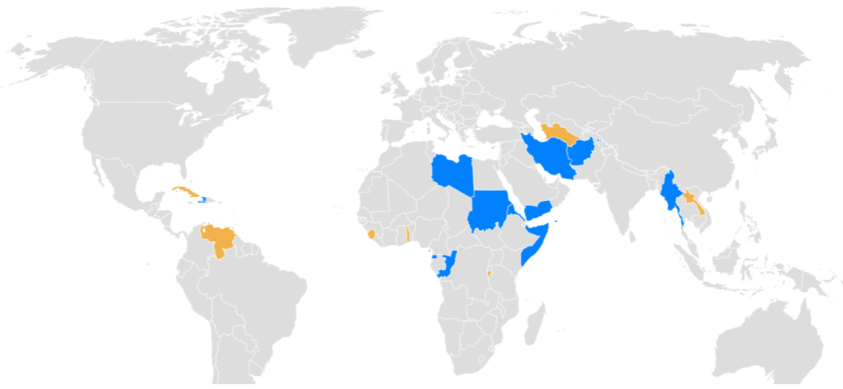
Who are “countries of concern”? On June 4, 2025, President Trump issued a Presidential Proclamation Restricting the Entry of Foreign Nationals to Protect the United States from Foreign Terrorists and Other National Security and Public Threats.
This is a travel ban on nationals from 19 “countries of concern.” The administration invokes national security and public safety as its justification for the travel ban. Specifically, the Proclamation states that the President “considered various factors, including each country’s screening and vetting capabilities, information sharing policies, and country-specific risk factors — including whether each country has a significant terrorist presence within its territory, its visa-overstay rate, and its cooperation with accepting back its removable nationals.”
Full Travel Ban: The ban fully suspends entry for immigrant and nonimmigrant nationals from these countries:
- Afghanistan
- Burma
- Chad
- Republic of Congo
- Equatorial Guinea
- Eritrea
- Haiti
- Iran
- Libya
- Somalia
- Sudan
- Yemen
Partial Travel Ban: The ban suspends entry for immigrant, B-1, B-2, B-1/B-2, F, M, and J visa holders, and reduces the of validity for other nonimmigrant visas (presumably to reciprocity schedule minimum) for the nationals of the following countries:
- Burundi
- Cuba
- Laos
- Sierra Leone
- Togo
- Turkmenistan
- Venezuela
There are limits on the trave ban’s scope, exceptions, and waivers, described in Trump Administration Revives Travel Ban – Chodorow Law Offices.
New Policy on Exercising Discretion
Many immigration benefits require the applicant to demonstrate that they merit a favorable exercise of discretion. This includes applications for adjustment of status, extension of nonimmigrant stay, change of nonimmigrant status, and waiver applications.
For these benefits, a discretionary analysis is a separate, additional component of adjudicating the benefit request. Whether to favorably exercise discretion is typically assessed after an officer has determined that the applicant meets all applicable threshold eligibility requirements.
The exercise of discretion is defined as a “balancing of the negative factors evidencing the alien’s undesirability …. with the [positive] social and humane considerations presented on his or her behalf to determine whether relief appears in the best interests of this country.”
Examples of negative factors include a criminal history and failure to pay taxes. Examples of positive factors include service in the U.S. armed forces, lengthy lawful residence in the U.S., and a steady employment record.
The Trump Administration’s new policy amends the USCIS Policy Manual to include this “significant negative factor”:
relevant country-specific facts and circumstances, such as insufficient vetting and screening information.
The Policy Manual cites to the Presidential proclamation discussed above for a list of “countries of concern” which share with the U.S. insufficient vetting and screening information.
The policy applies to applications pending or filed on or after Nov. 27, 2025.
The Policy Manual seems to imply that other country-specific facts and circumstances may include other factors that were considered in compiling the list of “countries of concern”: visa-overstay rates and cooperation in repatriation of their nationals who have been ordered deported.
The new policy is supposed to be applied on a “case-by-case basis” and not based on the “mere fact” that an individual is from a country of concern.
This example is given:
For example, if an alien’s conduct after admission as a nonimmigrant is inconsistent with the nonimmigrant status, and the alien is from a country with a high rate of overstay, then the officer may conclude that the alien’s conduct should be considered as a significantly negative factor.
This example of how to apply the policy strikes me as misguided. If an applicant has violated their nonimmigrant status in the past by engaging in behavior inconsistent with that status, such as by overstaying, I don’t understand why the violation should be considered a significant negative factor for an individual from a high-overstay-rate country but not for an individual from a low-overstay-rate country. This policy seems to enable frontline officers to engage in national origin discrimination.
Portions of this rule may be justifiable in cases when it serves the nation’s interest to deny an immigration benefit because the officer has no way to properly vet and screen the applicant to determine their identity and assess whether they have any criminal background or pose a security threat security threat. But it at least some cases it should be possible to vet and screen an applicant by interviewing sources in the U.S., such as neighbors, family members, schools, and/or employers. This is especially true in cases where the individual has resided in the United States (or a third country) for a lengthy period.
In cases where the applicant’s home country does not share sufficient vetting and screening information with USCIS, it will be important for applicants and their attorneys to gather alternative evidence of the applicant’s character, such as character references from family members, employers, teachers, and community leaders.
But the only example that the Policy Manual provides is misguided. This is not a good policy if it cannot be explained to officers clearly.
Leave a Reply